
Sources: Asphalt Roofing Manufacturers Association (ARMA), Owens Corning (May 2026). General guidance; your shingle maker’s instructions come first.
Asphalt shingle roof maintenance is mostly about protecting two things: the granules on the surface and the seal that holds each shingle down. The granules shield the asphalt from the sun, and the seal strip keeps wind from getting underneath. Nearly every problem on a shingle roof in North Mississippi starts when one of those two gives way.
Our roof maintenance checklist covers what to check each season. This guide goes a layer deeper into the shingles themselves: what each kind of wear means, what you can safely do about it, and what to leave to a roofer. If you would rather have someone look, our roof maintenance visits start with a free inspection.
What’s in this guide
- How asphalt shingles wear out
- Reading the signs: a problem-by-problem table
- Granules: the part to protect
- Black streaks, algae and moss
- Lifted tabs and nail pops
- The attic side of a shingle roof
- What can hurt your shingle warranty
- What we do on a maintenance visit
- Shingle roof maintenance questions
How Asphalt Shingles Wear Out
An asphalt shingle is a mat soaked in asphalt, with a layer of ceramic-coated granules pressed into the top. Asphalt is what keeps water out, and sunlight is what breaks it down. The granules are there to keep the sun off it. As long as they stay put, the asphalt underneath stays flexible.
Time, heat and weather knock granules off and dry the asphalt out. A dried-out shingle shrinks and stiffens, so its edges curl, it cracks in the cold, and its seal strip lets go in a strong gust.
In a place with long, humid summers and a spring storm season, both forces work on a roof every year. Good maintenance doesn’t stop that aging. It slows it down and catches the weak spots before water finds them.
Not all shingle roofs are the same, either. Three-tab and architectural shingles age differently, and our guide to residential roofing types explains the difference.
Reading the Signs: A Problem-by-Problem Table
Most of these can be spotted from the ground with binoculars, or from a window that looks out over a lower roof.
| What you see | What it usually means | What to do |
|---|---|---|
| Granules piled at the downspout outlets | Shingles shedding their surface; IBHS says some early shedding is expected, but a steady supply means wear | Watch it; have the roof looked at if it keeps up or bare spots show |
| Bare, dark patches on the slope | Asphalt exposed to the sun, from wear, scuffing or hail | Roofer: check whether it is local or across the roof |
| Edges curling up or the middle cupping | Shingles drying out, often from age or a hot attic | Roofer: judge remaining life and check the ventilation |
| A tab lifted, folded or missing | Seal strip broken by wind | Roofer: reseal or replace before the next storm |
| A bump with a nail head under it | Nail pop: the fastener backed out of the deck | Roofer: reset or replace the nail and seal the shingle |
| Black or dark streaks | Algae, mostly cosmetic | Clean gently, or leave it; see below |
| Green, fuzzy clumps | Moss holding moisture and lifting edges | Treat it, never scrape or pressure wash |
| Cracked rubber around a vent pipe | Pipe boot worn out by sun and heat | Roofer: replace the boot |
Compiled from ARMA and Owens Corning guidance cited in this post, and IBHS research on natural weathering.
Granules: The Part to Protect
Almost every maintenance rule for a shingle roof comes back to the granules. Lose them, and the asphalt underneath bakes and turns brittle.
- Keep foot traffic off it. Every step on a shingle on a hot day grinds granules loose. Satellite installers, gutter cleaners and well-meaning relatives all count.
- Never pressure wash. ARMA says pressure washing an asphalt shingle roof will cause granule loss, which can lead to premature roof failure. Owens Corning adds that it can displace granules and potentially void the manufacturer’s warranty.
- Clear debris gently. ARMA recommends a leaf blower or another non-abrasive method, with the air blowing down the slope so leaves aren’t pushed up under the shingle edges.
- Keep the gutters clear. A gutter full of debris holds water at the roof edge, and granules piling up in it tell you how fast the shingles are wearing.
Hail is the other big granule thief. After a storm, our roof inspection is free, and it tells you whether the marks are hail or ordinary wear.
Black Streaks, Algae and Moss
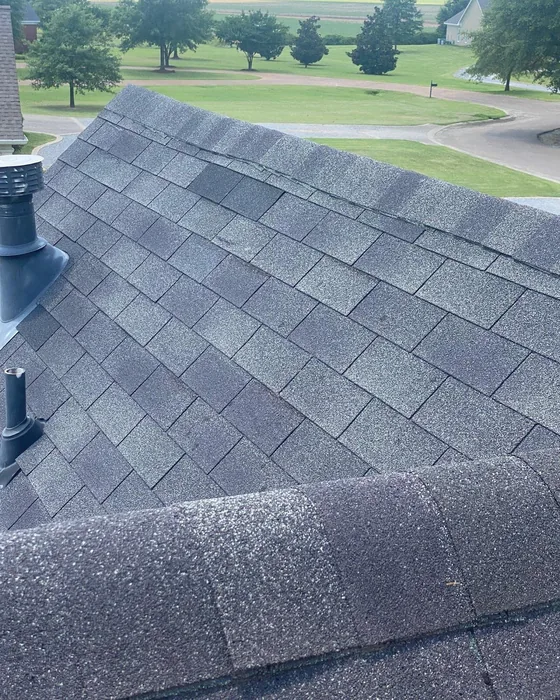
The dark streaks that run down so many roofs in the South are algae. Owens Corning notes that biological growth can trap moisture, which can affect shingle performance over time, but the streaks themselves are mainly a looks problem. Moss is more serious, because the clumps hold water against the roof and can lift shingle edges.
ARMA’s cleaning method is gentle on purpose:
- Mix laundry-strength liquid chlorine bleach with water, 50:50.
- Apply it with a garden sprayer and let it sit 15 to 20 minutes, without letting it dry completely.
- Rinse with low-pressure water. Algae usually keeps washing away with later rains; moss may need a second treatment and a leaf blower.
- Protect the plants below and wear protective gear.
Check your shingle maker’s instructions first, because mixing ratios differ by manufacturer, and Owens Corning says it does not test or recommend specific cleaning products. A wet, bleached roof is also slippery, so this is a job for a pro with the right gear on anything but a low, single-story roof. For what professional cleaning usually costs, see our guide to roof maintenance cost.
To slow the regrowth, ARMA suggests trimming limbs back so more sun reaches the roof. When the roof is eventually replaced, algae-resistant shingles are the long-term fix. ARMA advises against adding zinc or copper strips to an existing roof.
Lifted Tabs and Nail Pops
Each shingle is held down by nails and by a strip of sealant that the sun melts onto the shingle below it. Spring and summer thunderstorms break that seal on some shingles without tearing them off. A shingle with a broken seal can look perfectly flat, but the next gust gets under it, folds it back, and creases or tears it.
ARMA notes that shingles are repairable precisely because sealed shingles can be lifted by hand to reach the nails underneath, and then hand-sealed back down. That is the fix for a lifted tab or a nail pop, and it is a small job if it is done before the shingle tears. A cold, stiff shingle can crack when it is lifted, and walking a hot roof to find the loose ones scuffs the granules, so it is work for a roofer.
The Attic Side of a Shingle Roof
Shingles age from the bottom too. ARMA explains that attic ventilation moves heat and moisture out of the attic, and lists premature roof failure, shingles buckling as the deck moves, and rotting wood among the results of poor ventilation (ARMA, February 2023). In a Mississippi summer, that heat is the reason a shingle roof with a stuffy attic can curl years ahead of the house next door.
Two checks you can make: on a hot afternoon, see whether the attic feels like an oven, and look at the eaves from inside to see whether insulation has been pushed against the soffit vents. Either one is worth mentioning at your next inspection.
What Can Hurt Your Shingle Warranty
Shingle warranties come with conditions, and some common habits work against them. Owens Corning warns that pressure washing can potentially void manufacturer warranties, and ARMA says cleaning chemicals and methods shouldn’t be used without the shingle maker’s approval. Before you clean, coat or add anything to the roof, read your warranty or ask the manufacturer. Keep the paperwork from your last roof job, including the shingle brand and color name; ARMA notes that knowing the color name and install year helps a roofer match a repair later.
What We Do on a Maintenance Visit
Advance Roofing & Restoration is based in Hernando, and most of the roofs we look after are asphalt shingle. A maintenance visit is hands-on:
- Valleys and slopes cleared of leaves, pine straw and branches.
- Seals around vents, pipes and chimneys checked and resealed where they need it.
- Loose shingles and popped nails secured or replaced before wind gets under them.
- Flashing at walls and chimneys checked for gaps and rust.
- A straight answer on anything bigger, like bare patches, curling shingles or soft spots in the deck.
The inspection and the estimate are free. Any maintenance work is quoted in that estimate, and nothing starts without your go-ahead. If the shingles are worn thin across most of the roof, we will tell you a roof replacement is the better plan.
We look after shingle roofs in Hernando, Southaven, Olive Branch, Horn Lake, Byhalia, Coldwater, Senatobia and over the line in Memphis. See our roof maintenance service or use the form on this page.
Shingle Roof Maintenance Questions
How do you maintain an asphalt shingle roof?
Keep the granules and the seals intact. Stay off the roof, never pressure wash it, clear debris gently with a leaf blower blowing down the slope, keep the gutters clean, and have lifted tabs, nail pops and cracked pipe boots fixed before the next storm. A yearly inspection catches the rest.
Can you pressure wash asphalt shingles?
No. ARMA says pressure washing an asphalt shingle roof will cause granule loss, which can lead to premature failure, and Owens Corning warns it can void the manufacturer's warranty. Algae and moss are treated with a low-pressure method instead.
What causes black streaks on a shingle roof?
Algae. The streaks are mostly cosmetic, though growth can hold moisture on the roof. ARMA's method is a 50:50 mix of laundry-strength bleach and water, left on 15 to 20 minutes and rinsed with low-pressure water, after checking your shingle maker's instructions.
Is it normal for shingles to lose granules?
Some is. IBHS notes shingles are made with extra granules and shedding those is expected. Steady piles of granules at the downspouts on an older roof, or bare dark patches on the slope, mean the shingles are wearing thin or were hit by hail, and the roof should be looked at.
Why are my shingles curling?
Curling and cupping usually mean the shingles are drying out, from age, sun and often a hot, poorly ventilated attic. ARMA lists buckling shingles and premature roof failure among the results of poor attic ventilation. A roofer can tell you how much life is left and whether the attic needs more airflow.
How often should a shingle roof be maintained?
Check it from the ground each season and after storms, clean the gutters at least twice a year, and have a roofer look at it once a year. Our roof maintenance checklist lays out the season-by-season list for homes in this area.